
 Insurance & Claims
Does Homeowners Insurance Cover Roof Replacement?
Sudden storm damage from hail, wind, wind-driven rain, or a fallen tree is usually covered. Wear, age, and neglect are not. Here is how to tell which one you have.



 Licensed & Insured
NC #85568
By Patriots’ Roofing · Updated June 2026 · Insurance & Claims
TL;DR: Homeowners insurance generally pays to replace a roof damaged by a sudden, covered peril such as hail, high wind, wind-driven rain, or a fallen tree. It does not pay to replace a roof that simply wore out, aged, or was poorly maintained. What you actually receive depends on whether your policy pays replacement cost value or actual cash value, your wind and hail deductible, and how well the storm damage is documented.
The short answer, and the line insurers draw
Insurance exists to make you whole after something sudden and accidental happens, not to replace materials that reached the end of their service life. That single idea explains almost every roof claim decision. If a covered peril hits your roof on a specific date, your carrier generally pays to restore it. If an adjuster decides the roof failed from age, granule loss over many years, or deferred maintenance, the claim is denied as wear and tear. Most disputes come down to which side of that line your roof falls on, which is exactly why proof of a storm event matters so much.
The good news for storm-belt homeowners is that hail, straight-line wind, wind-driven rain, and falling limbs are the textbook covered perils. We help homeowners across West Texas, Eastern North Carolina, the Outer Banks, and coastal Louisiana sort the real storm damage from ordinary aging, and document it the way a carrier needs to see it. You can read how we handle the full process on our storm damage and insurance claims page.
Covered vs. not covered, at a glance
Coverage turns on the cause of the damage, not the age of the roof by itself. A 15-year-old roof with legitimate hail bruising is generally covered; a 15-year-old roof that is simply worn out is not. Here is how carriers typically treat the most common situations.
| What caused the damage | Covered by a standard policy? |
|---|---|
| Hail strikes from a dated storm event | Usually |
| High wind that lifts, creases, or tears off shingles | Usually |
| Wind-driven rain entering after the roof is breached | Often |
| A tree or large limb falling on the roof | Usually |
| Sudden, accidental events such as fire | Usually |
| Normal aging, granule loss, and worn-out shingles | No |
| Deferred maintenance or neglect | No |
| Improper original installation or manufacturing defect | No |
| Cosmetic-only marks with no functional damage | Varies |
Storm damage that is commonly covered
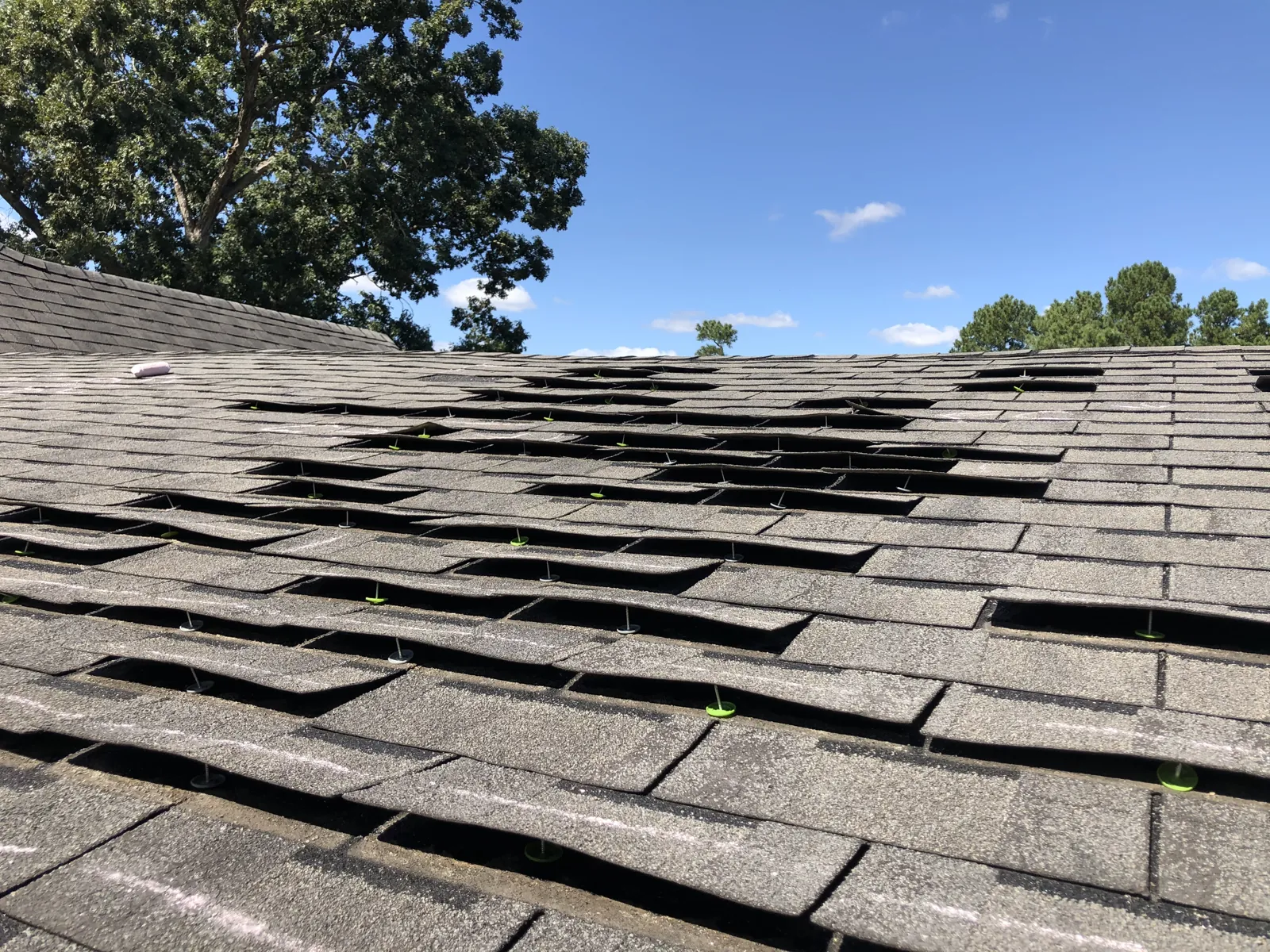
When a real storm hits, the damage is often invisible from the driveway. A hailstone can fracture the shingle mat and strip the protective granules while your sidewalk and gutters look untouched. These are the items we most often find and document on a covered claim:
- Hail bruising and fractured shingles
- Granule loss exposing the asphalt mat
- Wind-lifted, creased, or missing shingles
- Dented metal vents, flashing, and gutters
- Cracked or displaced ridge caps
- Torn underlayment along eaves and rakes
- Damaged pipe boots and turtle vents
- Interior leaks and fresh ceiling stains
Not sure if your roof has a claim?
Talk to a local roofing and insurance-claim expert who climbs the roof, documents every elevation, and tells you straight whether the damage is covered. No cost, no obligation.
Get My Free Estimate → Or call us(844) 585-7663ACV vs. RCV: what your policy actually pays
Two phrases decide how much money reaches you, so it pays to know which one is on your policy.
Replacement cost value (RCV) pays what it costs to replace the roof with new materials of like kind and quality, with no deduction for age. Most modern homeowner policies are written this way. Actual cash value (ACV) pays the depreciated value, meaning the carrier subtracts for the roof’s age and wear before paying. On an older roof, the ACV figure can be much lower than the full cost of the work.
On an RCV policy the payout usually arrives in two parts. The carrier first releases the ACV amount, then holds back the difference as recoverable depreciation. Once the roof is completed and the final invoice is submitted, that held-back depreciation is released, so the policy ultimately covers the full approved scope minus your deductible. Knowing whether your policy is RCV or ACV before you file tells you what to expect, and it is one of the first things we review with you.
Deductibles and the wind/hail line item
You always pay your deductible; insurance covers the rest of the approved, covered scope. Two details surprise homeowners. First, many policies in hail and hurricane regions carry a separate wind and hail deductible, often written as a percentage of the home’s insured value rather than a flat dollar amount, so it can be larger than your standard deductible. Second, the deductible is your responsibility by law in most states; be cautious of any contractor who offers to waive, absorb, or rebate it, because that practice is illegal in many states and can void your claim. A legitimate roofer documents the real damage and bills the real scope.
How age and condition affect your coverage
Roof age does not by itself disqualify a storm claim, but it changes the conversation. Many carriers now cap older roofs at ACV-only settlement or apply a roof-age schedule, and some non-renew or surcharge homes with roofs past a certain age. After a covered loss the carrier still pays for storm damage, but on an aging roof the depreciation can be significant. The practical takeaway: file promptly after a storm rather than letting a damaged roof sit, keep your maintenance records, and replace a worn roof before age erodes both its protection and your coverage.
If you are weighing whether a roof is storm-damaged or just old, the honest first step is the same either way: a free roof inspection from a roofer who actually gets on the roof. We will tell you plainly which one you have.
Why documentation makes or breaks the claim
The difference between an approved roof replacement and a denied claim is usually evidence. Adjusters are trained to separate fresh storm damage from long-term wear, and they decide from what they can see and measure. We photograph every elevation, mark each hail strike and wind tear, and tie the damage to a dated storm event, so the full, legitimate scope is on the record rather than lost between the ground and the gutter. We will also meet your adjuster on the roof so everyone is describing the same damage. For the full sequence, see our step-by-step guide on how to file a roof insurance claim after a hail storm, and our hands-on help with roof insurance claims in Lubbock.
Grant money is a separate path worth knowing
An insurance claim is not the only way to fund a stronger roof. Coastal homeowners may also tap FORTIFIED grant programs that are completely separate from a claim. North Carolina’s Strengthen Your Roof program offers up to $10,000 toward a qualifying FORTIFIED roof, a related coastal grant offers up to $6,000, and Louisiana’s Fortify Homes program offers up to $10,000 for eligible Gulf Coast homes. These grants fund a fortified, code-plus roof and can stack alongside the savings that often come with impact-resistant materials. As an IBHS FORTIFIED certified installer, we can tell you whether your address falls in an eligible territory.
Frequently Asked Questions
Does homeowners insurance cover a full roof replacement?
Yes, when a covered peril caused the damage and a repair will not restore the roof. Standard homeowner policies cover sudden events such as hail, high wind, wind-driven rain, and fallen trees. If the storm damage is widespread or the shingles are no longer manufactured, carriers commonly approve a full replacement rather than a patch. What is not covered is a roof that simply wore out from age or neglect.
Will insurance pay for an old roof damaged by hail?
It can. Roof age alone does not disqualify a storm claim, so legitimate hail or wind damage on an older roof is still a covered loss. The catch is the payout type: many carriers settle older roofs at actual cash value, which deducts for age and wear, instead of full replacement cost value. Reviewing whether your policy is RCV or ACV before you file tells you what to expect.
What roof damage is NOT covered by insurance?
Insurance does not pay for normal aging, granule loss over time, worn-out shingles, deferred maintenance, neglect, improper original installation, or manufacturer defects. Some policies also exclude purely cosmetic marks that do not affect how the roof performs. In short, carriers cover sudden accidental damage, not the gradual end of a roof’s service life.
What is the difference between ACV and RCV on a roof claim?
Replacement cost value (RCV) pays what it costs to replace the roof with new materials of like kind and quality, with no deduction for age. Actual cash value (ACV) pays the depreciated value, subtracting for the roof’s age and wear. On RCV policies the carrier usually releases the ACV amount first, then pays the held-back recoverable depreciation once the work is completed and invoiced, so you ultimately receive the full approved scope minus your deductible.
Do I still pay my deductible if insurance covers the roof?
Yes. You always pay your deductible, and insurance covers the rest of the approved, covered scope. In hail and hurricane regions, many policies carry a separate wind and hail deductible that can be a percentage of the home’s insured value rather than a flat amount. Be cautious of any contractor offering to waive or absorb your deductible, since that practice is illegal in many states and can jeopardize your claim.
Think a Storm Damaged Your Roof?
Let a fifth-generation, family-owned crew document the damage and stand with you through your insurance claim. One free inspection tells you whether you have a covered roof replacement.