
 Materials & Cost
Roof Replacement Cost on the Outer Banks and Eastern NC (2026)
What actually drives the price of a coastal roof, why barrier-island homes cost more than inland ones, and how the NC FORTIFIED grant can take a real bite out of the bill.

 Licensed & Insured
NC #85568
By Patriots’ Roofing · Updated June 2026 · Materials & Cost
TL;DR: Roof replacement cost on the Outer Banks and in Eastern NC is driven by roof size, pitch, material, and the coastal code upgrades a barrier-island home needs (sealed deck, ring-shank nails, salt-air-rated metal). Industry-typical asphalt re-roofs run roughly $4.50 to $8.00 per square foot installed; metal runs higher. Coastal builds cost more than inland ones, but the NC FORTIFIED grant can reimburse up to $6,000 or $10,000, and a free on-site estimate is the only way to get your real number.
What a coastal roof replacement actually costs
There is no honest single price for a roof, and any contractor who quotes one over the phone is guessing. What we can give you is the math the whole industry works from. A roof is priced by the “square” (a 10 by 10 foot area, or 100 square feet), and for architectural asphalt shingles the industry-typical installed range lands around $4.50 to $8.00 per square foot, which varies with everything below. Standing-seam and other metal systems, which a lot of Outer Banks homeowners choose for the salt air and wind, typically run noticeably higher, often in the $9.00 to $16.00 per square foot range. Those are broad, typical figures meant to set expectations, not a Patriots’ Roofing price list. Your actual roof replacement cost on the Outer Banks depends on the specific factors that follow, and the only way to pin it down is a measured, on-site estimate.
The factors that move the number
Two homes on the same street can be thousands of dollars apart. Here is what separates them:
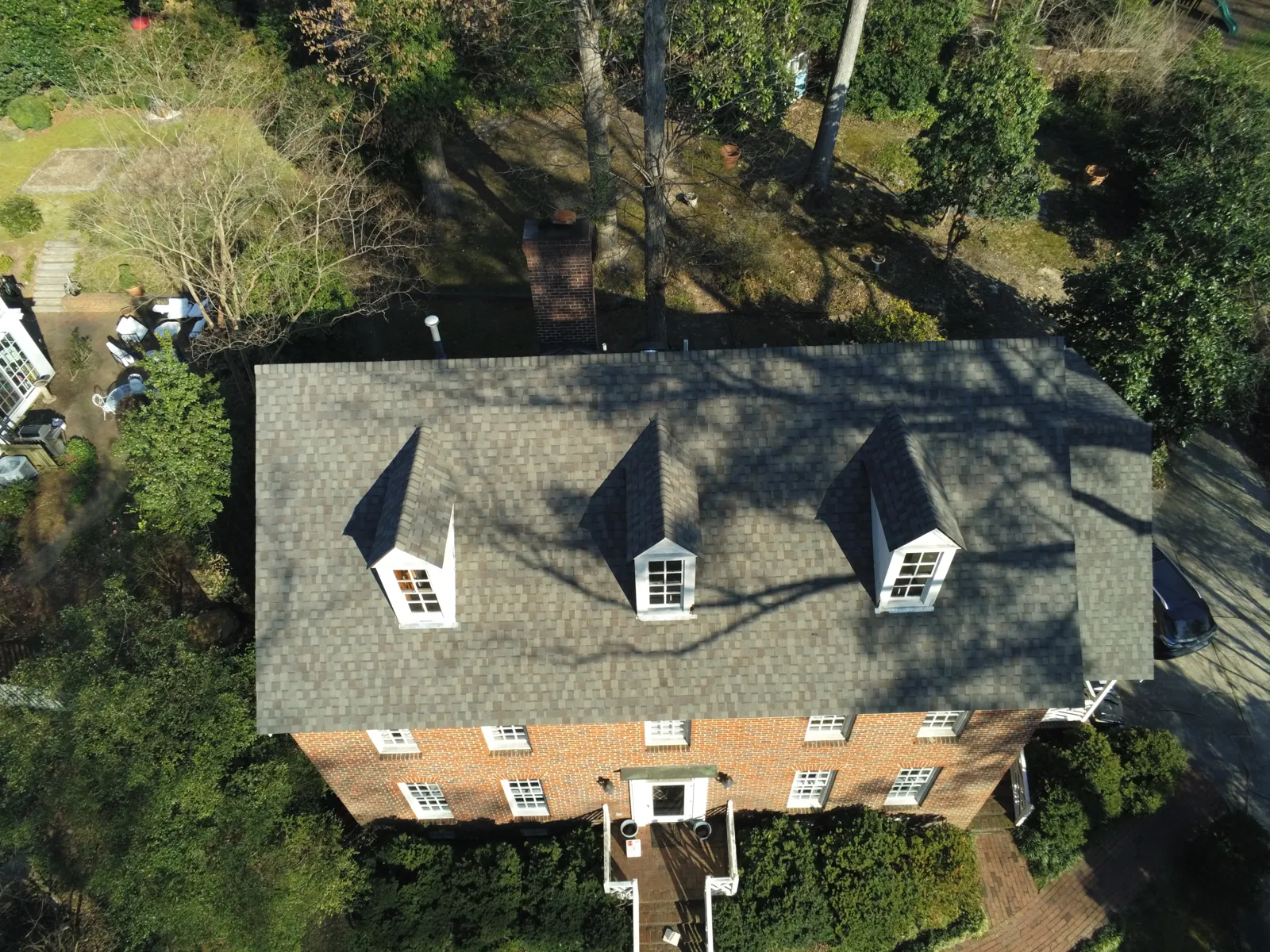
- Roof size and shape. More squares means more material and labor. A simple gable roof is cheaper per square than a cut-up roof with multiple hips, valleys, dormers, and skylights, because the complex one takes more flashing, more cuts, and more time.
- Pitch and stories. A steep roof, or a two- or three-story coastal home, needs more staging, fall protection, and slower, careful work. Walkable low-slope roofs are quicker and cost less to install.
- Material choice. Architectural asphalt shingles are the value baseline. Premium designer shingles cost more, and standing-seam metal costs the most of the common options, while lasting the longest in salt air.
- Coastal code upgrades. Homes near the ocean are built to a tougher wind standard. A fully sealed roof deck, ring-shank nails on a tighter nailing pattern, and enhanced edge metal are not optional extras here; they are how a coastal roof stays on.
- Salt-air-rated components. Corrosion-resistant fasteners, flashing, drip edge, and vents cost more than the standard parts used inland, and they are worth every penny within sight of the water.
- Tear-off and decking repair. Removing old layers is labor, and coastal humidity rots decking. Soft or rotten plywood found during tear-off has to be replaced, and that is usually priced per sheet on top of the base roof.
- Access and logistics. Barrier-island sites, tight lots, long dumpster hauls, and limited staging room all add cost compared with an easy inland driveway.
None of those is padding. They are the difference between a roof that survives the next named storm and one that ends up as a tarp and an insurance claim. For the full picture of a coastal tear-off and rebuild, see our guide to roof replacement on the Outer Banks.
Why coastal roofs cost more than inland ones
A roof in Lubbock and a roof in Nags Head are not the same product, even with the same shingle on top. The coastal build carries upgrades an inland roof simply does not need. The single biggest driver is the wind and water standard: on the barrier islands, the roof has to resist hurricane-force uplift and keep wind-driven rain out even if shingles are torn off. That means a sealed deck, a stronger nailing schedule, and edge details that an inland roof can skip. Add corrosion-resistant components for the salt air, more decking replacement because humidity is harder on plywood, and harder site access, and the coastal roof lands higher. The good news is that the same upgrades that raise the price are exactly what the state will help pay for.
Standard re-roof vs FORTIFIED coastal roof
Here is the difference between a plain re-roof and a roof built to the IBHS FORTIFIED standard, which is the version the NC grant funds:
| Feature | FORTIFIED coastal roof | Standard re-roof |
|---|---|---|
| Sealed roof deck (taped seams) | Yes | No |
| Ring-shank nails, tighter pattern | Yes | No |
| Enhanced edge metal and detailing | Yes | No |
| Documented and certified for the grant | Yes | No |
| Eligible for NC FORTIFIED grant reimbursement | Yes | No |
How the NC FORTIFIED grant offsets the cost
This is the part that changes the math for coastal homeowners. North Carolina runs grant programs that reimburse the cost of a new IBHS FORTIFIED roof. On the Outer Banks and Barrier Islands the Strengthen Your Roof program reimburses up to $10,000, and on the 18 mainland coastal counties the Strengthen Your Coastal Roof program reimburses up to $6,000. It is a reimbursement cap, not a coupon: if your FORTIFIED roof costs more than the cap you receive the full cap, and if it costs less you are reimbursed the actual amount. For many coastal homes, that grant covers a large share of the upgrade cost, which is why a FORTIFIED roof can end up costing a homeowner little more out of pocket than a standard re-roof, while performing far better in a storm. The roof has to earn the FORTIFIED designation and be installed by an IBHS-certified contractor to qualify, and funds are first-come while they last. We walk through the dollars, territories, and eligibility on our page for the NC FORTIFIED grant, and explain the building standard itself under FORTIFIED roofing.
How to get your real number
Ranges are useful for planning, but they will not get a permit pulled. A real price comes from someone climbing the roof, measuring it, counting the squares, checking the decking, and writing down the upgrades your home and your insurance require. That is what a Patriots’ Roofing estimate is, and it is free. We are a family-owned, fifth-generation roofing company, founded by the O’Brien family in 1836, and we run a local Eastern North Carolina crew rather than chasing storms across the bridge. We are GAF Master Elite and President’s Club, an IBHS FORTIFIED certified installer, BBB A+ accredited, and rated 4.9 on Google. We are proud to serve the veterans, first responders, and military families up and down the coast. Tell us your address and we will tell you what your roof actually costs, grant included.
Talk to a local roofing expert
Skip the phone guesses. A local, IBHS-certified Patriots’ Roofing estimator will measure your roof, walk the coastal upgrades, and show you how the FORTIFIED grant changes your out-of-pocket cost, all at no charge.
Get My Free Estimate → Or call us(844) 585-7663Frequently Asked Questions
How much does a roof replacement cost on the Outer Banks?
It varies by roof. Industry-typical installed pricing for architectural asphalt shingles runs roughly $4.50 to $8.00 per square foot, and metal systems typically run higher, often $9.00 to $16.00 per square foot. Your real number depends on size, pitch, material, decking condition, and the coastal code upgrades your home needs. A free on-site measurement is the only way to get an accurate price.
Why do coastal roofs cost more than inland roofs?
Barrier-island homes are built to a tougher wind and water standard, so the roof needs a sealed deck, ring-shank nails on a tighter pattern, and enhanced edge metal that an inland roof can skip. Add corrosion-resistant components for the salt air, more decking replacement from humidity, and harder site access, and the coastal build lands higher than the same shingle inland.
Does the NC FORTIFIED grant reduce my roof replacement cost?
Yes. North Carolina reimburses up to $10,000 for a new FORTIFIED roof on the Outer Banks and Barrier Islands, and up to $6,000 in the 18 mainland coastal counties. It is a reimbursement cap, so it can cover a large share of a coastal roof’s cost. The roof must earn the FORTIFIED designation and be installed by an IBHS-certified contractor, and funds are first-come while they last.
Does a metal roof cost more than shingles on the coast?
Generally yes. Standing-seam and other metal systems typically cost more upfront than architectural asphalt shingles, often in the $9.00 to $16.00 per square foot industry-typical range. Many coastal homeowners still choose metal because it holds up well in salt air and high wind and lasts longer, which can lower the lifetime cost.
How do I get an exact price for my roof?
Have it measured. A Patriots’ Roofing estimator climbs the roof, counts the squares, checks the decking, and itemizes the coastal upgrades and any insurance requirements, then gives you a written price. The estimate is free, and we will factor the FORTIFIED grant into your out-of-pocket cost. Call (844) 585-7663 or request an estimate online.
Keep Reading
- Roof replacement on the Outer Banks – what a full coastal tear-off and rebuild involves.
- The NC FORTIFIED grant – how the $6,000 and $10,000 reimbursements work and who qualifies.
- FORTIFIED roofing – the IBHS building standard behind the grant.
Know What Your Coastal Roof Will Really Cost
Get a measured, written price from a local, IBHS-certified, family-owned crew, with the FORTIFIED grant factored in. No phone guesses, no obligation.