
 Insurance & Claims
Roof Inspection Checklist: What a Free Inspection Should Cover
A real inspection goes well past a glance from the driveway. Here is the point-by-point checklist a thorough roofer should work through, inside and out.


 Licensed & Insured
NC #85568
By Patriots’ Roofing · Updated June 2026 · Insurance & Claims
TL;DR: A thorough roof inspection works through the shingles (bruising, granule loss, cracks, lifting), then the flashing, valleys, vents, and pipe boots, the ridge and drip edge, and the gutters. It does not stop at the roof surface; a real inspection also goes into the attic to check for leaks, daylight, moisture, and poor ventilation. You should walk away with a dated photo report you can keep. Patriots’ Roofing offers all of this free, with no obligation.
What a real roof inspection covers
A roof inspection is only as useful as the checklist behind it. A quick look from the ground, or a fast trip up a ladder to one corner, will miss the problems that actually cost you money: the cracked pipe boot, the lifted flashing, the soft spot in the decking you cannot see from below. A proper inspection is methodical. It walks the entire roof surface, checks every penetration and edge, and then goes inside to read the story the attic tells. Below is the same point-by-point checklist our crews use, so you know what good looks like, whether we do the inspection or someone else does.
The shingles: where damage shows up first
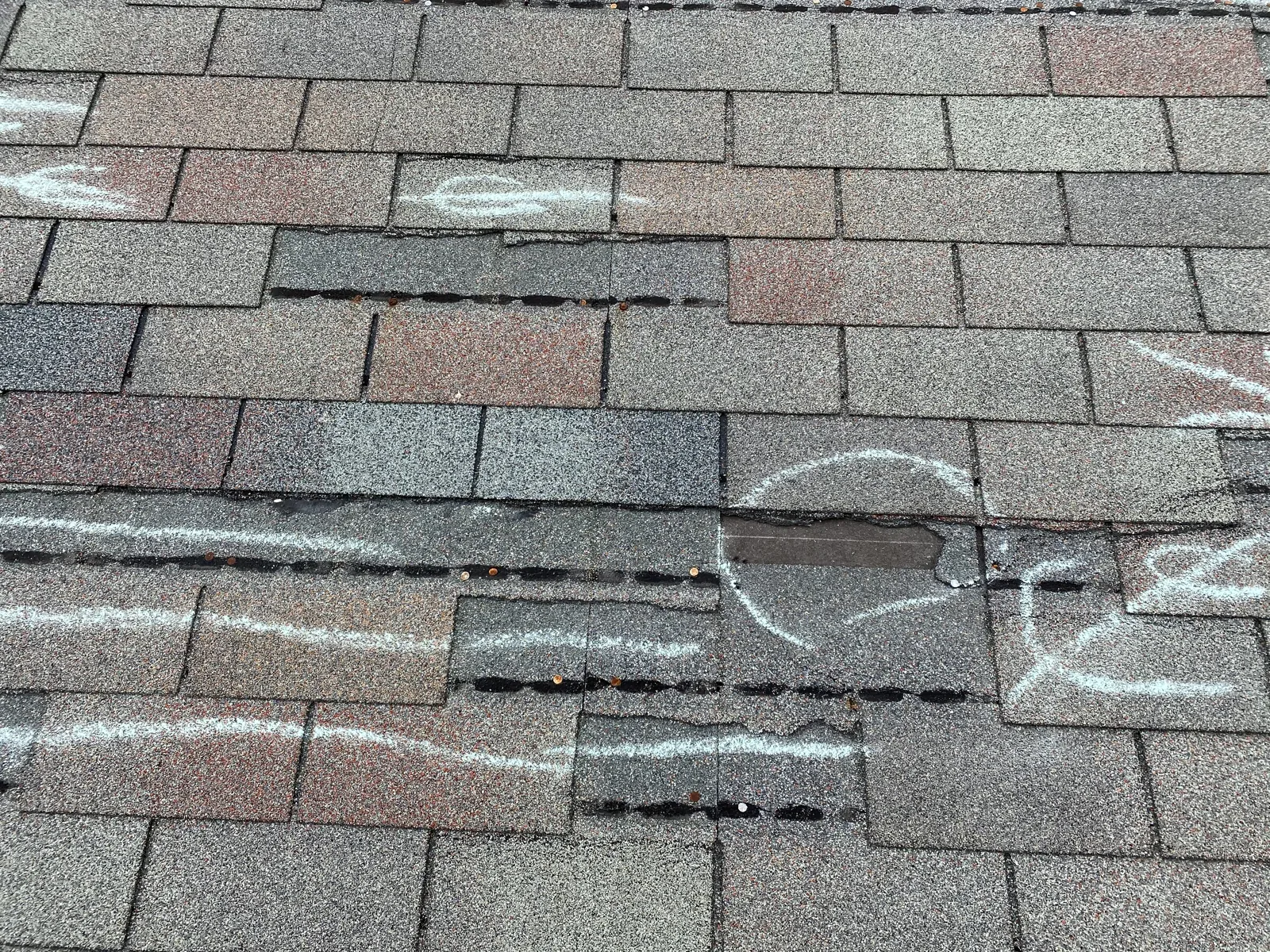
The field of shingles is the largest surface and the first place wear and storm damage appear. A careful inspector is not just looking for missing shingles; they are reading the condition of the ones that are still there.
- Bruising and soft spots from hail, where the mat is fractured even if the surface looks intact. These are felt as much as seen, and they are easy to miss from the ground.
- Granule loss that exposes the black asphalt mat. Bare spots and granules collecting in the gutters both signal a roof aging out or storm-struck.
- Cracking, curling, and clawing from heat and age, which let water under the shingle.
- Lifting or unsealed tabs from wind, where the adhesive strip has let go and the next gust can peel the shingle back.
- Exposed or backed-out nails and improper fastening, a common source of slow leaks.
Hail and wind damage in particular can be subtle. If a recent storm is the reason you are looking, it is worth understanding how to tell if your roof has hail damage before an inspector ever climbs up, so you can ask the right questions.
Flashing, valleys, and penetrations
Most roof leaks do not start in the open field of shingles. They start where the roof is interrupted: a chimney, a wall, a vent pipe, a skylight, a valley where two planes meet. These transition points are where a thorough checklist earns its keep.
- Flashing around chimneys, walls, and skylights, checked for rust, separation, lifting, or failed sealant.
- Valleys, the channels that carry the most water, checked for wear, debris, and damaged metal or shingle.
- Pipe boots, the rubber collars around plumbing vents, which crack and dry-rot faster than the roof around them and are a leading cause of leaks.
- Roof vents and exhaust caps, checked for cracks, loose fasteners, and proper seating.
- Skylight seals and curbs, inspected for gaps and failed glazing.
Edges, ridge, and gutters
The perimeter of the roof and the line at the very top do specific jobs, and a checklist should confirm each is intact.
- Ridge and hip caps, checked for cracking, lifting, or missing pieces along the peak.
- Ridge vent, confirmed to be open and working so the attic can breathe.
- Drip edge along the eaves and rakes, which directs water into the gutter and protects the deck edge; a surprising number of roofs are missing it.
- Gutters and downspouts, checked for granule buildup (a tell-tale of shingle wear), sagging, separation, and proper drainage away from the foundation.
- Fascia and soffit, inspected for rot and water staining that hint at a hidden leak.
The attic: the half most people skip
This is the difference between a real inspection and a surface look. The attic is where a leak shows itself long before it stains your ceiling, and where ventilation problems quietly shorten a roof’s life. Skipping it is skipping half the diagnosis.
- Active leaks and water stains on the underside of the deck and on rafters, which pinpoint where water is getting in.
- Daylight showing through the decking or around penetrations, a clear sign of a gap.
- Moisture, mold, or wet insulation, which point to a leak or a ventilation failure.
- Decking condition, checked for sagging, soft spots, and rot that the surface hides.
- Ventilation and insulation, confirmed to be balanced and unblocked; poor airflow bakes shingles from below and drives up energy bills.
The documented photo report: proof you can keep
An inspection that lives only in the inspector’s head is worth very little, especially if you may file an insurance claim. A good inspection ends with documentation you can hold onto and hand to an adjuster.
- Clear, dated photos of every finding, close enough to show the actual condition.
- The location of each issue noted, so a finding can be tied back to a spot on the roof.
- An honest summary of the roof’s overall condition and remaining life.
- A plain-language recommendation: monitor, repair, or replace, with the reasoning spelled out.
That report is what turns an inspection into something you can act on, and it is exactly what an insurance adjuster wants to see when storm damage is involved.
Drive-by look vs. a documented inspection
| What gets checked | Quick drive-by look | Documented Patriots’ inspection |
|---|---|---|
| Roof surface walked and shingles checked up close | No | Yes |
| Flashing, valleys, and pipe boots inspected | No | Yes |
| Attic checked for leaks, moisture, and ventilation | No | Yes |
| Every finding photo-documented and dated | No | Yes |
| Written report you can keep | No | Yes |
| Useful for an insurance claim | No | Yes |
When you book a free roof inspection with us, this is the standard, not a paid upgrade. There is no charge and no obligation to do any work afterward. If you are local, you can request a free roof inspection in Lubbock the same way.
Talk to a local roofing expert
Not sure what shape your roof is in? We will walk the whole checklist, inside and out, and hand you a photo report in plain language. Free, with no pressure and no obligation.
Get My Free Estimate →Or call us(844) 585-7663Frequently Asked Questions
What should a roof inspection checklist cover?
A complete checklist covers the shingles (bruising, granule loss, cracking, curling, and lifting), the flashing around chimneys and walls, the valleys, the pipe boots and roof vents, the ridge and hip caps, the drip edge, and the gutters and downspouts. It then moves inside to the attic to check for leaks, water stains, daylight, moisture, decking condition, and ventilation. A thorough inspection ends with a dated photo report.
Does a roof inspection include the attic?
It should. The attic is where a leak shows up long before it stains your ceiling, and where ventilation and decking problems are visible. An inspection that only looks at the roof surface is skipping half the diagnosis. Our crews check the underside of the decking, the rafters, the insulation, and the airflow as a standard part of every inspection.
How often should I have my roof inspected?
A good rule of thumb is at least once a year, and again after any major hail or wind storm. Older roofs and roofs that have already taken storm damage benefit from being checked more often. Catching a small problem early, like a cracked pipe boot or lifted flashing, is far cheaper than repairing the water damage it causes later.
Is the roof inspection really free, and what do I get afterward?
Yes. Patriots’ Roofing inspects your roof at no charge and with no obligation to have any work done. Afterward you get an honest assessment of the roof’s condition, dated photos of any findings, and a plain-language recommendation to monitor, repair, or replace, with the reasoning explained so you can decide for yourself.
Can a roof inspection help with an insurance claim?
It can be the foundation of one. A documented inspection with clear, dated photos of storm damage is exactly what an adjuster needs to evaluate a claim. As a GAF Master Elite and President’s Club contractor with deep storm and insurance experience, we document findings the way the claims process expects and can walk you through the next steps.
Get the full checklist run on your roof
From the shingles to the attic, we inspect every point on the list and hand you a photo report you can keep. GAF Master Elite and President’s Club, BBB A+, 4.9 stars on Google. Free and no obligation.