
 Storm & Seasonal
Hail Season in Amarillo: A Panhandle Roof Survival Guide
The Texas Panhandle takes some of the hardest hail hits in the country, and the storm record proves it. Here is what those storms do to a shingle roof, when a claim makes sense, and how to be ready before the next supercell fires.



 Licensed & Insured
NC #85568
By Patriots’ Roofing · Updated July 2026 · Storm & Seasonal
TL;DR: Amarillo hail season peaks from late spring into early summer, and the Panhandle’s biggest documented storms all landed in that window: baseball-size hail in Amarillo in May 2013, baseball hail and 80 mph winds around Happy and Fritch in June 2023, and 3-inch hail in Canyon in June 2025. Hail bruises composition shingles, strips granules, and fractures the mat, and most of that damage is invisible from the ground. After any significant storm, get a free documented inspection first, then file a claim only if the damage is real.
The Panhandle’s hail record: three storms worth remembering
Amarillo sits about 3,600 feet up on the High Plains, in the heart of what meteorologists call Hail Alley. At this elevation a falling hailstone passes through less warm air before it lands, so it arrives bigger and harder, and the spring dryline gives supercells a reliable trigger. Three documented events tell the story of what an Amarillo roof is actually up against.
- May 28, 2013, Amarillo. The National Weather Service documented hail up to baseball size in the city, with golf-ball hail piling up at the NWS office itself. The stones stripped trees, ruined vehicle finishes at local dealerships, broke skylights, and destroyed the plantings at the Amarillo Botanical Gardens.
- June 11-12, 2023, Happy and Fritch. Overnight supercells raked the Panhandle from both directions. Happy took baseball-size hail driven by winds near 80 mph, breaking windows and shredding trees, and tennis-ball-to-baseball hail hammered Fritch just before 5 a.m.
- June 8, 2025, Canyon. A storm rolling through between 2 and 3 a.m. dropped hail the National Weather Service measured at 3 inches, riding on 84 mph winds. City officials counted more than 200 damaged homes, and the mayor signed a disaster declaration that same afternoon.
Notice the pattern: all three storms hit between late May and mid June, and two arrived in the middle of the night. Panhandle hail peaks when the dryline is most active, plays favorites street by street, and does not wait for daylight.
What hail actually does to a composition shingle
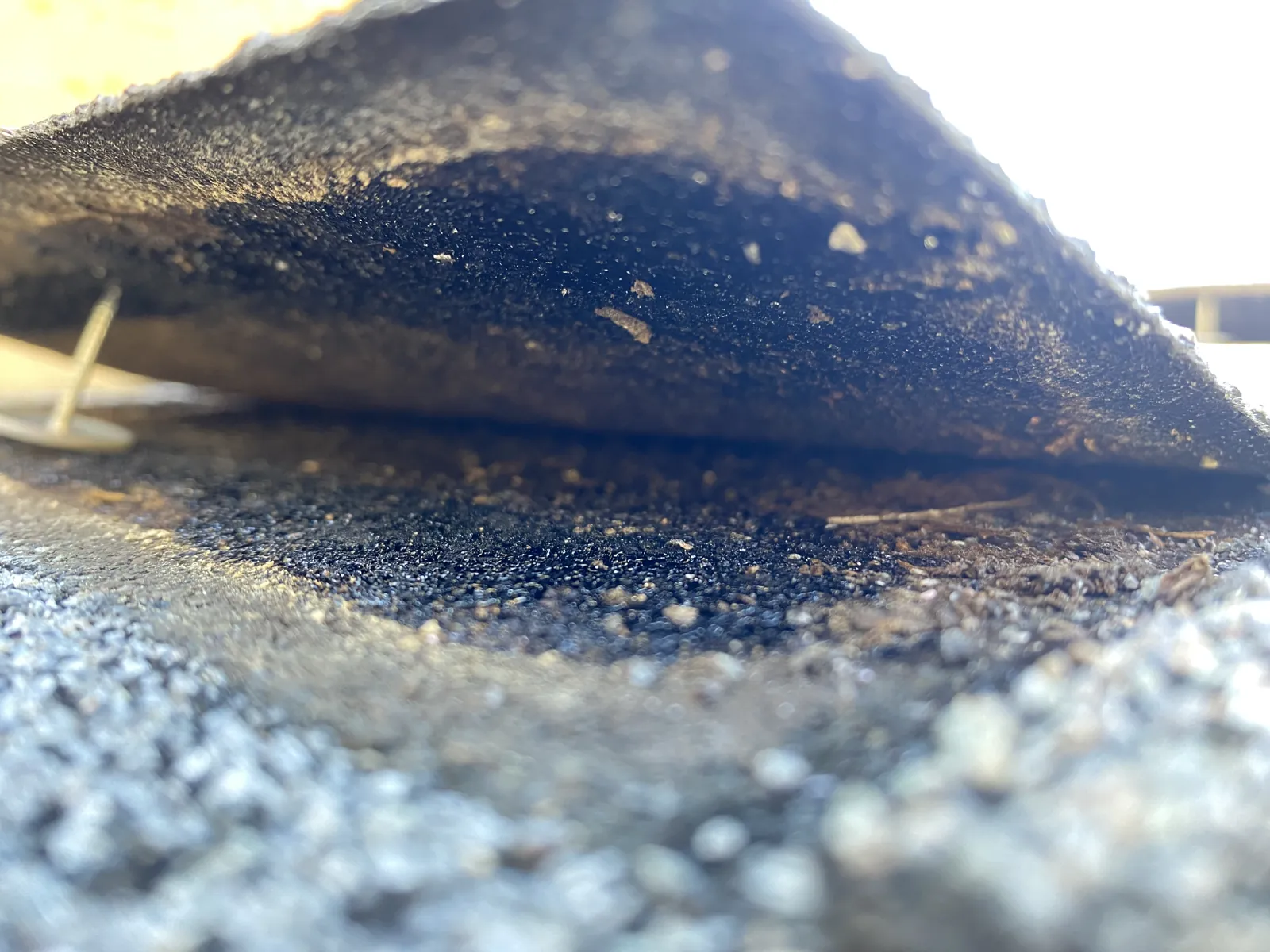
A composition shingle is a fiberglass mat coated in asphalt and armored with ceramic granules. The granules are the shingle’s sunscreen; they block the UV radiation that turns asphalt brittle. When a hailstone hits, it does three things at once: it knocks granules loose, it bruises the asphalt layer the way a thumb bruises an apple, and, if the stone is big enough or the shingle old enough, it fractures the mat underneath.
Here is the part most homeowners miss: a hail-bruised roof usually does not leak right away. The fracture sits under the surface while sun and weather work on the exposed spot, and the leak arrives a year or three later, often after the claim window has closed. That delayed failure is why carriers treat fractured mats and heavy granule loss as functional damage, and why a roof that looks fine from the driveway still deserves a real inspection.
A rough field guide to hail size
Not every hailstone is a roof killer. Damage depends on stone size, shingle age and condition, and how much wind is pushing it. Treat this table as a field guide, not a verdict; only a slope-by-slope inspection settles what happened on your roof.
| Hail size | Common comparison | What it typically means for a composition roof |
|---|---|---|
| Under 1 inch | Pea to quarter | Usually cosmetic on newer roofs; can scour granules off aging or brittle shingles |
| 1 to 1.75 inches | Quarter to golf ball | The common bruising threshold; expect granule loss, soft-metal dents, and possible mat damage |
| 1.75 to 2.5 inches | Golf ball to tennis ball | Fractured mats, cracked shingles, damaged vents and flashing become likely |
| 2.5 inches and up | Tennis ball to baseball and beyond | Punctures, broken windows, and widespread functional damage; inspect regardless of appearance |
Wind changes the math. A 1-inch stone in a calm shower lands differently than the same stone driven sideways at 80 mph, which is what Happy and Canyon both experienced. If your storm came with damaging wind, treat the size guide as one full step more severe.
When to file a claim, and when to hold off
Filing a hail claim is the right move when the damage is functional and documented. It is the wrong move when the roof came through clean, because a claim with no payable damage still goes on your record. The order of operations matters, and it starts with the inspection, not the phone call to your carrier.
- Get the roof inspected first. Have a local roofer walk every slope, chalk and photograph each impact, and give you a straight answer on whether the damage is functional. If it is not, you just saved yourself a claim.
- Pin down the storm date. Carriers tie every hail claim to a specific date of loss. Write down when the storm hit and keep any photos, news reports, or neighborhood evidence that confirms it.
- Review your policy before you call. Know whether you carry a separate wind and hail deductible and how your policy handles roof coverage, so nothing in the adjuster’s report surprises you.
- Report promptly and meet the adjuster with your roofer present. Policies expect timely notice, and having the contractor who documented the damage on the roof with the adjuster keeps the scope honest.
- Review the scope before work begins. Make sure everything the storm damaged, from shingles to vents to gutters, is in the estimate, and address gaps through the supplement process.
We walk Panhandle homeowners through this start to finish, from the first chalk mark to the final walkthrough; our storm damage and insurance claims page explains exactly how we document a roof and work a claim.
Class 4 impact-resistant shingles, built for hail country
If your roof is due for replacement anyway, hail country is the place where the upgrade to a Class 4 impact-resistant shingle earns its keep. Class 4 is the top rating under the UL 2218 standard, which drops a 2-inch steel ball on the same spot of a shingle twice; the shingle passes only if the mat does not crack. The stones that bruise a standard shingle tend to bounce off a Class 4 product with little more than a scuff.
There is a financial angle too. The Texas Department of Insurance allows carriers to offer premium credits for impact-resistant roofing, and many insurers writing Panhandle policies do. The credit varies by carrier and policy, so ask your agent what a Class 4 roof would do to your premium before you choose materials. We hold GAF Master Elite and President’s Club status, and the Class 4 GAF shingles we put on remain eligible for the 50-year Golden Pledge warranty, so the hail upgrade costs you nothing in coverage. If a replacement is on your horizon, start with our roof replacement page.

Before the next storm: readiness beats reaction
The 2025 Canyon storm hit at 2 a.m. The 2023 Fritch hail arrived just before 5 a.m. You will not outrun a Panhandle hailstorm, but you can make sure the aftermath goes your way.
- Photograph your roof while it is healthy. Dated photos of a sound roof are the cleanest before-and-after evidence a claim can have.
- Know your deductible structure now. Many Texas policies carry a separate wind and hail deductible calculated as a percentage of your dwelling coverage. Find out which kind you have before you need it.
- Pick your roofer before the storm does. Big hail events pull out-of-town storm chasers into Amarillo neighborhoods within days. Knowing a local, established contractor ahead of time means you are never signing with a stranger on your porch. Our guide on how to choose a roofing contractor covers the red flags.
- Recheck after every significant storm, not just the historic ones. Repeated smaller hits age a roof fast, and the storm that finally opens a leak is often the third or fourth one, not the first.
Not sure what the last storm did to your roof?
We inspect Panhandle roofs slope by slope, photograph everything, and tell you plainly whether you have a claim or a sound roof. The inspection is free either way, with no pressure attached.
Get My Free Estimate →Or call us(844) 585-7663Frequently Asked Questions
When does hail season peak in Amarillo?
Hail season in Amarillo runs from spring into early summer, with the peak in late May and June when the dryline is most active over the High Plains. The Panhandle’s biggest documented recent storms, in May 2013, June 2023, and June 2025, all hit inside that window, and storms can flare again in early fall. Late-night hail is common, so do not assume you would have seen the storm that hit your roof.
What are the biggest recent hailstorms near Amarillo?
Three stand out. On May 28, 2013, the National Weather Service documented hail up to baseball size in Amarillo that damaged skylights, vehicles, and the Amarillo Botanical Gardens. On June 11-12, 2023, overnight supercells dropped baseball-size hail with winds near 80 mph on Happy and tennis-ball-to-baseball hail on Fritch. On June 8, 2025, Canyon took 3-inch hail on 84 mph winds; city officials counted more than 200 damaged homes and the mayor declared a disaster the same day.
Can hail damage my roof without any visible signs from the ground?
Yes, and that is the normal case, not the exception. Hail damage on a composition roof shows up as granule loss, bruising, and fractured mats on the upward-facing slopes, none of which is visible from the driveway. A bruised shingle often does not leak until one to three years later, after sun and weather finish what the stone started. Ground-level clues like dented gutters and splatter marks prove a storm hit hard; proving roof damage takes an inspection on the roof itself.
Should I file an insurance claim after every hailstorm?
No. File when a documented inspection confirms functional damage such as fractured mats, heavy granule loss, or broken shingles, because a claim with no payable damage still goes on your claims record. Have a local roofer inspect and photograph the roof first, confirm the storm date, review your wind and hail deductible, and then report without delay once the inspection confirms damage. Policies require timely notice, so do not let seasons pass on a damaged roof.
Do Class 4 shingles qualify for an insurance discount in Texas?
Often, yes. The Texas Department of Insurance allows carriers to offer premium credits for impact-resistant roofing, and many insurers writing Panhandle policies do. The amount varies by carrier and policy, so ask your agent specifically what a UL 2218 Class 4 roof would do to your premium. In a market with Amarillo’s hail history, the credit plus the reduced storm damage is why many homeowners choose Class 4 at their next replacement.
Ready for the Next Panhandle Hail Season
Whether you want a Class 4 roof before the storms arrive or a documented inspection after one already came through, our fifth-generation, family-owned company, founded by the O’Brien family in 1836, will tell you exactly where you stand at no cost.