
 Storm & Seasonal
Storm Damage Roof Guide for Raleigh and the Triangle
Raleigh sits 130 miles from the beach, yet Triangle roofs take hits from thunderstorm wind, hail, tornadoes, and hurricane remnants. Here is how to find the damage those storms hide and turn it into a clean insurance claim.



 Licensed & Insured
NC #85568
By Patriots’ Roofing · Updated July 2026 · Storm & Seasonal
TL;DR: The Triangle takes roof damage from four directions: severe thunderstorm wind, hail, tornadoes, and the remnants of hurricanes that push far inland (Fran carried hurricane-force gusts all the way to Raleigh in 1996). The most expensive wind damage is usually invisible from the street, so after any strong storm, note the date, photograph what you can see from the ground, and get a slope-by-slope documented inspection before deciding on a claim. Raleigh sits outside North Carolina’s coastal grant territories, but you can still choose a FORTIFIED roof as a voluntary upgrade.
Yes, Raleigh gets real storm damage
Homeowners in Wake, Durham, and Orange counties sometimes assume serious roof damage is a coastal problem. The record says otherwise. When Hurricane Fran came ashore near the Cape Fear coast on September 5, 1996 as a Category 3 storm, it did not stop at the beach. The National Weather Service documented hurricane-force gusts as far inland as Raleigh, including a 79 mph gust measured in the city, and the combination of extreme wind and saturated ground dropped hundreds of thousands of trees across central North Carolina, many of them onto roofs.
Tornadoes reach the Triangle too. On April 16, 2011, thirty tornadoes touched down across North Carolina in a single afternoon, the largest one-day outbreak in state history according to the National Weather Service. One of them, rated EF3, stayed on the ground for more than 60 miles from near Sanford into Raleigh itself, damaging homes through the heart of the metro. And in an ordinary year, the bigger threat is more routine: spring and summer thunderstorms that drop hail and push straight-line gusts strong enough to crease shingles and peel flashing without ever making the evening news.
Hidden wind damage: what you cannot see from the driveway
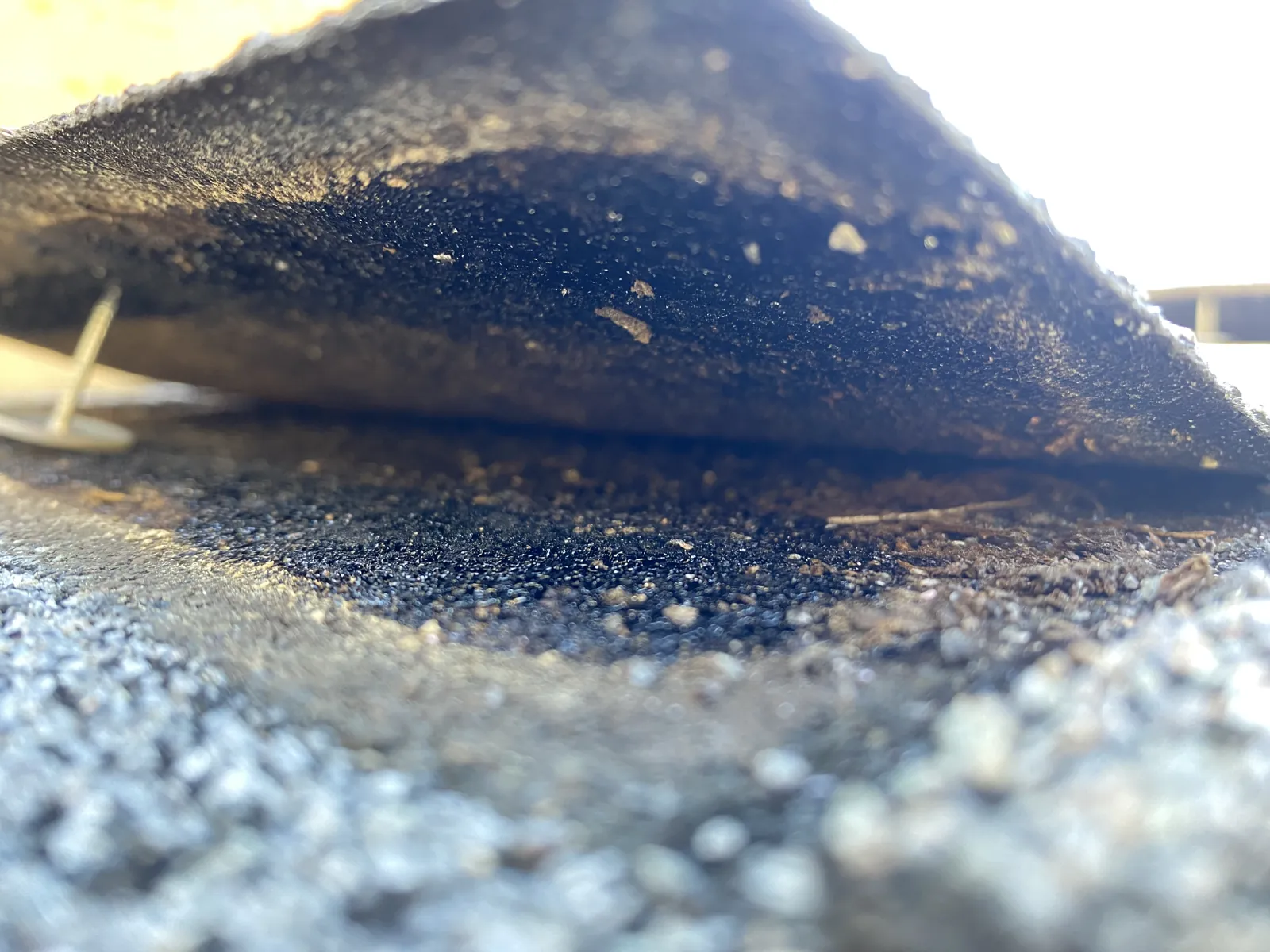
A tree through the deck announces itself. Wind damage usually does not. Gusts work on a roof by flexing it: shingles lift for a moment, fold back against their own mat, then settle down again looking almost normal. The crease is a fracture, and the broken adhesive seal beneath it means that shingle will lift more easily in every storm that follows. From the street, the roof looks fine. Two winters later, it leaks.
Here is what a trained eye looks for after Triangle wind events:
- Creased or folded shingles. A horizontal line across a shingle tab means it lifted and snapped back. The shingle is broken even though it is still in place.
- Broken seal strips. Shingles that lift by hand with no resistance have lost their wind seal and will keep peeling in future storms.
- Damage clustered on one slope. Wind loads the slopes facing the gust. One rough slope and three clean ones is a classic wind signature.
- Lifted or bent flashing and ridge caps. The ridge and edges catch the strongest uplift, so they fail first.
- Shingle pieces or tabs in the yard. Fragments on the ground mean the field of the roof has open wounds somewhere above.
- Attic evidence. Water stains on the decking, damp insulation, or pinholes of daylight after a storm point to breaches you cannot see outside.
Hail hits the Triangle too
The same thunderstorms that bring damaging gusts to Raleigh, Cary, Durham, and Chapel Hill regularly drop hail, especially in spring. Hail does not usually tear shingles off; it bruises them. An impact crushes the granule layer into the asphalt mat, and the bruise sheds granules and weathers into a soft spot that eventually leaks. Like wind creases, hail bruises hide on the upward-facing slopes where nobody looks.
The ground tells you whether it is worth checking: dented gutters and downspouts, dinged vent caps, splatter marks on fences and AC fins, and a heavy wash of granules at the downspout outlets after the storm. If you see those, the roof deserves a closer look. Our guide to how to tell if your roof has hail damage walks through the roof-level evidence in detail.
The first days after a storm, in order
What you do in the first few days sets up everything that follows, including the insurance claim if there is one.
- Confirm everyone is safe. Stay clear of downed lines, leaning trees, and any sagging section of roof or ceiling.
- Write down the date and time. Insurance carriers tie a claim to a specific documented storm. That one note anchors the whole file.
- Survey from the ground. Circle the house looking for missing shingles, debris, dented metal, and fragments in the yard. Stay off the roof.
- Photograph everything visible. Wide shots of each side of the house plus close-ups of any damage, with the date stamps intact.
- Protect against further water. If there is an active leak, a professionally installed tarp keeps the damage from growing, and the receipt belongs in your claim file.
- Book a documented inspection. An inspector covers every slope, marking and photographing each point of damage, then gives you an honest read on whether what is up there justifies a claim.
Documentation is what wins the claim
Most North Carolina homeowners policies cover wind and hail damage, subject to your deductible, but coverage on paper only pays when the file proves what happened. The strongest claims share three things: a storm date that matches a real, documented weather event; photographs that show the damage clearly, slope by slope; and an inspection report from a contractor who put hands on the roof rather than binoculars on it. That is exactly the package we build during a free inspection, and it is why our team walks homeowners through storm damage insurance claims from first photos to final adjuster meeting.
Two habits protect you along the way. First, do not make permanent repairs before the adjuster has seen the roof; temporary protection is expected, but replacing shingles ahead of the inspection can erase the evidence. Second, have your roofer present at the adjuster meeting. An adjuster scopes dozens of roofs a week, and a contractor who has already documented every crease and bruise makes sure nothing gets missed.
Not sure what that last storm did?
A local Patriots’ Roofing inspector will walk every slope, document what the storm actually did, and give you a straight answer about whether a claim makes sense. The inspection is free either way.
Get My Free Estimate →Or call us(844) 585-7663Repair or replace after storm damage?
Not every storm-damaged roof needs a new roof. Damage confined to one slope or a handful of shingles, with a sound deck underneath, is usually a candidate for professional roof repair: replacing the broken shingles, re-seating flashing, and re-sealing the ridge. Widespread creasing, bruising across multiple slopes, or a roof already near the end of its life tips the answer toward full replacement, because patching a failing field just moves the next leak a few feet over.
One Triangle-specific wrinkle: if your shingle color or product line has been discontinued, spot repairs may be impossible to match, and a visible checkerboard on the front slope is its own problem. A good estimator will tell you honestly which side of the line your roof falls on, and show you the photos that back it up.
Building back stronger: FORTIFIED as a voluntary upgrade
One honest note about incentives: North Carolina’s FORTIFIED roof grant programs are aimed at the coastal territories, and Raleigh sits outside them, so there is no grant money for a Triangle re-roof. What is available to any homeowner, anywhere in the state, is the standard itself. FORTIFIED is a re-roofing method from the Insurance Institute for Business & Home Safety built around a sealed roof deck, ring-shank nails, and locked-down edges, and those upgrades earn their keep inland: they are engineered against exactly the uplift that hurricane remnants and severe thunderstorm gusts put on a Triangle roof.
If Fran taught central North Carolina anything, it is that hurricane-force wind does not check the county line. A sealed deck that keeps rain out of the attic even where shingles fail is worth considering on any re-roof here, and some carriers recognize wind-resistant construction on premiums, so ask your agent what your policy offers. Patriots’ Roofing is an IBHS FORTIFIED certified installer in North Carolina, so the option is on the table whenever you replace.
Patriots’ Roofing is family-owned and fifth-generation, founded by the O’Brien family in 1836, and we are proud to serve veterans, first responders, and military families across the state. As a GAF Master Elite and President’s Club contractor, we back qualifying replacements with the 50-year Golden Pledge warranty, and our Raleigh roofing team handles everything from storm inspections to full FORTIFIED re-roofs with local crews, not storm chasers.
Frequently Asked Questions
Can my roof have wind damage even if no shingles are missing?
Yes, and this is the most common surprise in Triangle storm claims. Wind lifts shingles, creases them against their own mat, and breaks the adhesive seal strips, then the shingles settle back into place looking normal from the ground. The creases and broken seals are real functional damage that leads to leaks and further peeling in later storms, and they only show up in a slope-by-slope roof-level inspection.
What kinds of storms damage roofs in Raleigh and the Triangle?
Four kinds. Severe spring and summer thunderstorms bring straight-line wind and hail. Tornadoes are a documented Triangle threat; the April 16, 2011 outbreak put thirty tornadoes on the ground across North Carolina in one day, including an EF3 that tracked from near Sanford into Raleigh. And hurricane remnants push far inland, as Hurricane Fran did in September 1996 when it carried hurricane-force gusts to Raleigh and downed trees across the region.
Does homeowners insurance cover storm damage to a roof in North Carolina?
Most North Carolina homeowners policies cover wind and hail damage, subject to your deductible and the specific terms of your policy. What decides the outcome is documentation: a claim tied to a real, documented storm date, clear photographs, and a slope-by-slope inspection report. Review your own policy and deductible with your agent, and get the roof professionally documented before you decide whether to file.
Should I file an insurance claim after every storm?
No. File when a documented inspection shows real, claim-worthy damage. Filing for damage that turns out to be minor or below your deductible gains you nothing and still goes on your claims history. The better sequence is to note the storm date, photograph what you can see from the ground, and have a roofer document the roof first. If the damage is real, file promptly, because policies expect timely notice of a loss.
Can Raleigh homeowners get the NC FORTIFIED roof grant?
No. North Carolina’s FORTIFIED grant programs apply to designated coastal territories, and Raleigh and the Triangle sit outside them. The FORTIFIED standard itself is still available to any homeowner as a voluntary upgrade at replacement time, and its sealed deck, ring-shank nails, and reinforced edges are engineered against the same wind that hurricane remnants and severe thunderstorms bring inland. Some carriers recognize wind-resistant construction on premiums, so ask your agent.
After the Storm, Get a Straight Answer
Our fifth-generation, family-owned team inspects Triangle roofs for free, documents what the storm actually did, and tells you honestly whether you need a repair, a replacement, or nothing at all.