
 Storm & Seasonal
The Wilmington Homeowner Hurricane Roof Checklist
From Wrightsville Beach to Leland, the Cape Fear region learned in 2018 what a slow hurricane does to a roof. Here is the checklist to work through before the next one gets a name.


 Licensed & Insured
NC #85568
By Patriots’ Roofing · Updated July 2026 · Storm & Seasonal
TL;DR: Wilmington hurricane roof prep works in three phases. Before June 1, pull your roof’s records, get the shingle bond and flashing checked, trim the canopy, and shoot a clear-day photo baseline of every slope. Once a storm has a name, finish only the safe, ground-level items and get your documents reachable. If you are re-roofing at all, a FORTIFIED roof with a sealed deck is the single upgrade that addresses what actually failed here during Florence, and New Hanover County homeowners with an NCIUA coastal policy may qualify for grant help toward one. After a storm, photograph everything before any temporary repair and let a local contractor meet the adjuster with you.
What Florence taught Wilmington about roofs
Hurricane Florence came ashore at Wrightsville Beach at 7:15 a.m. on September 14, 2018, as a Category 1 hurricane with 90 mph sustained winds. On paper, a Category 1 is the bottom rung of the scale. In practice, Wilmington International Airport clocked a peak gust of 105 mph, the storm then slowed to a crawl, and it rained on the Cape Fear region for days. A gauge near Elizabethtown measured 35.93 inches, a new North Carolina tropical cyclone rainfall record, and for a stretch Wilmington was cut off from the rest of the state entirely as floodwater closed the roads in.
That sequence is the whole lesson. The category number measures wind speed at landfall; it says nothing about how long the storm sits on you. Around Wilmington, most roof losses in Florence followed the same script: the first hours of wind lifted shingles or pried up an edge, and then days of wind-driven rain poured through the opening into attics, ceilings, and walls. The roofs that came through were not necessarily the newest. They were the ones with nothing loose for the wind to grab and, on the best-built homes, a deck that stayed sealed even where the shingles did not.
So a Cape Fear hurricane checklist has two jobs: remove every loose edge the wind can start with, and make sure that if the covering does fail, the water stays out anyway.
Phase 1: the pre-season checklist (before June 1)
The Atlantic season opens June 1, and the calm months before it are when this list is cheap and easy. Everything here happens from the ground, the attic, or a professional’s ladder; nothing requires you to walk your own roof.
- Pull the roof’s paperwork. Find the install date, the shingle’s wind rating, and whether the manufacturer warranty was registered in your name. If you cannot answer “how old is this roof,” that is the first thing an inspection settles.
- Have the shingle bond checked. A large share of Wilmington-area roofs went on in the rebuild after Florence, which means they are now several seasons old. The self-seal strips that hold shingle tabs down weaken with age and heat, and a bond that has let go is invisible from the driveway.
- Walk the attic after a hard rain. Look for fresh staining on the decking, damp or matted insulation, and daylight around pipe boots and vents. A pinhole leak in May is a ceiling collapse in a five-day rain event.
- Silence everything that rattles. Drip edge, ridge vents, gable trim, and gutter runs loosen a little every year. If a piece of metal moves in a spring breeze, a hurricane will remove it and then work on the hole it leaves.
- Trim the canopy. Wilmington’s live oaks and loblolly pines are half the reason the town is beautiful and half the reason its roofs get hurt. Cut back anything overhanging the roofline while the tree crews have open schedules.
- Shoot a clear-day baseline. Photograph every slope from the ground, plus close-ups of flashing, penetrations, and gutters, and park the set in a cloud folder with the dates intact. In a post-storm claim, this is the document that separates new damage from old wear.
- Reread your policy’s wind provisions. Many coastal policies carry a separate named-storm or hurricane deductible calculated as a percentage of your dwelling coverage rather than a flat figure. Know which one you have and how it triggers before a forecast cone ever appears; your agent can walk you through it.
Phase 2: when the storm has a name (the 72-hour list)
Once the National Hurricane Center puts the Cape Fear coast in the cone, the useful window for roof work is over. This phase is about the ground, the paperwork, and staying off ladders.
- Get your documents reachable. Policy number, agent contact, deductible terms, and your baseline photos, all accessible from a phone in case you evacuate. Florence proved you may not be able to drive back for days.
- Clear the yard, not the roof. Furniture, planters, trampolines, and downed limbs become projectiles aimed at your shingles and windows. Moving them is the highest-value hour of storm prep left.
- Flush gutters and downspouts if it is still calm. The roof is about to shed more water in three days than it normally sees in a season; give it somewhere to go.
- Do a final ground-level scan. Note anything visibly loose and photograph it. Do not attempt last-minute repairs on the roof itself; a fall risk now also muddies what the storm did versus what you did.
- Decide who you will call after. Save the number of a local, established roofer now. After a landfall, out-of-town door-knockers arrive before the floodwater leaves, and the homeowners who fare worst are the ones choosing a contractor from a truck magnet.
The upgrade that matches the actual failure mode: a sealed roof deck
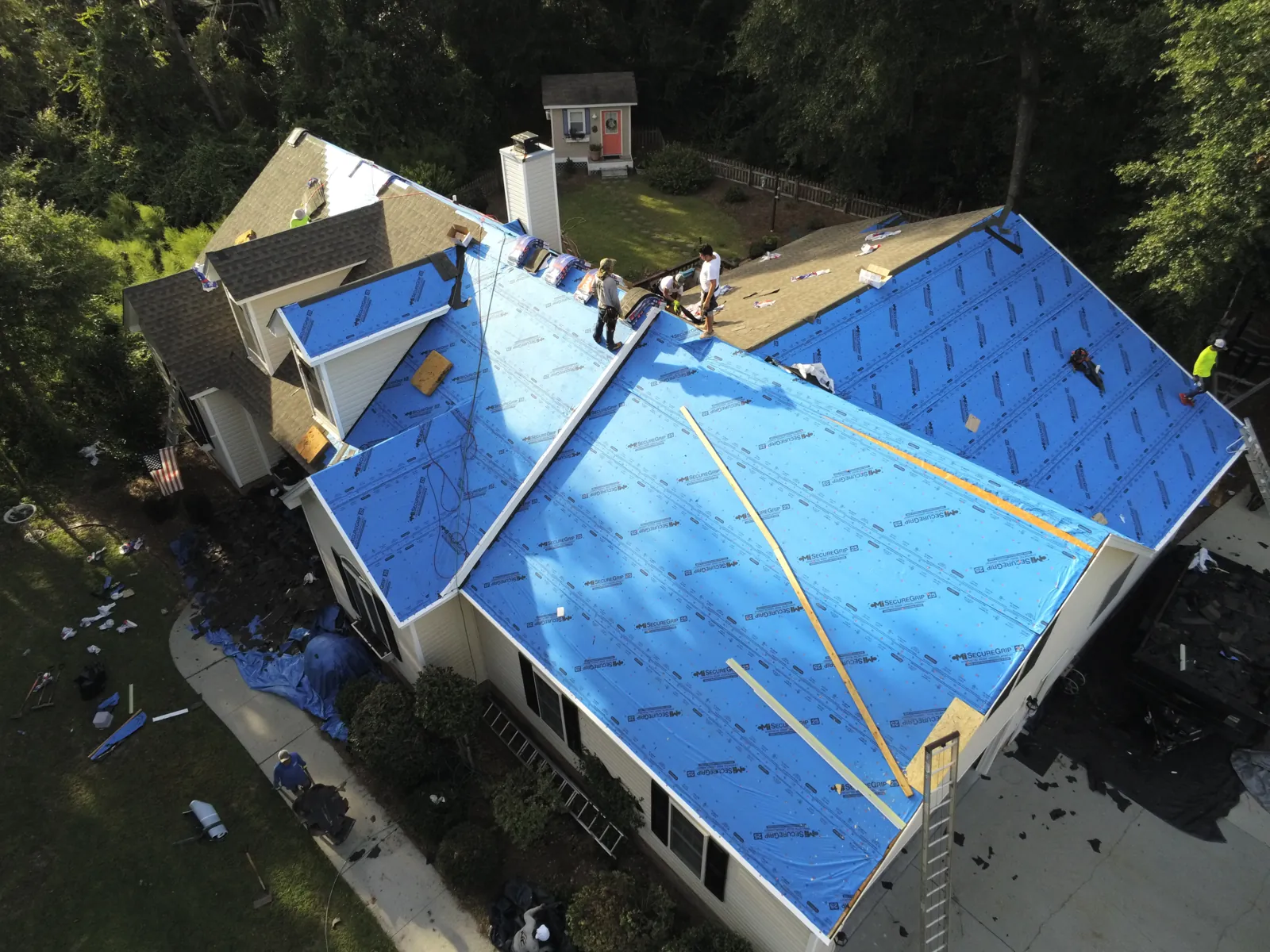
Every item above hardens the roof you have. If your roof is near the end of its life anyway, the Cape Fear question is what to rebuild it to, and Florence answered it. The FORTIFIED Roof standard from the Insurance Institute for Business & Home Safety was engineered around exactly the failure sequence this region lived through: it fastens the deck with ring-shank nails on a tighter pattern so uplift cannot pry it loose, locks down the edges and starter course where uplift first finds leverage, and, most importantly for a rain-heavy storm, seals the seams of the roof deck itself. IBHS testing shows a sealed deck can prevent up to 95 percent of the water that would otherwise pour into a home after the shingles are gone. In a storm that rains for days, that difference is the house.
| Detail | Typical re-roof | FORTIFIED Roof |
|---|---|---|
| Deck seams taped and sealed against rain | No | Yes |
| Ring-shank nails on an enhanced pattern | Not required | Yes |
| Reinforced edge and starter detail | Not required | Yes |
| Third-party designation certificate | No | Yes |
| Can qualify for NC coastal grant help | No | Yes |
The designation is not a marketing phrase; an independent evaluator verifies the installation and the home earns a certificate that insurers recognize. The full standard, and what it takes to earn it, is on our FORTIFIED roofing page.
New Hanover County and the NC coastal grant
North Carolina helps coastal homeowners fund this exact upgrade, and New Hanover County is inside the map. North Carolina’s Strengthen Your Coastal Roof program, run through the NCIUA coastal insurance pool, covers eighteen mainland coastal counties, New Hanover among them, and reimburses a meaningful share of a qualifying FORTIFIED re-roof. The gates matter: you must hold an active NCIUA coastal policy (a standard-carrier policy does not qualify), the finished roof must earn the official FORTIFIED designation, and since November 1, 2025, the installation must be done by an IBHS-certified FORTIFIED roofing contractor. Funding is first-come while it lasts, so the program rewards homeowners who start early in the season rather than after a storm.
Because the certified-contractor rule is now in force, who installs the roof is itself part of eligibility. Patriots’ Roofing holds that IBHS certification in North Carolina; we build to the standard, coordinate the independent evaluator, and manage the designation paperwork the grant depends on. Territories, eligibility, and how the application works are laid out on our NC FORTIFIED grant page.
Get your Cape Fear roof checked before the season peaks
A local Patriots’ Roofing estimator will inspect the shingle bond, flashing, and edges a hurricane goes after first, and tell you honestly whether your roof needs attention or just a baseline photo set. The inspection is free and there is no pressure either way.
Get My Free Estimate →Or call us(844) 585-7663Phase 3: after the storm, document like the adjuster will
If the Cape Fear takes another hit, the claim is won or lost in the first days, and mostly with a camera. Photograph the damage from the ground before anyone makes a temporary repair, wide shots first, then close-ups, from the same angles as your clear-day baseline if you can. Note the storm’s name and the date, keep receipts for tarps or emergency dry-in work (reasonable temporary protection is generally part of the claim, and your policy expects you to prevent further damage), and resist signing anything on the doorstep while the neighborhood is still full of out-of-state trucks.
Then get a full, slope-by-slope inspection from an established local company and have that contractor meet your adjuster on the roof, so everyone is pricing the same damage. That meeting is where a documented file, before photos, after photos, and a written scope, does its work. Our storm damage and insurance claims team handles that process across Eastern North Carolina, and our Wilmington roofing crews are local year-round, not just after landfall.
Frequently Asked Questions
When should Wilmington homeowners start hurricane roof prep?
Before June 1, when the Atlantic season opens. The pre-season work, checking the shingle bond and flashing, trimming trees, shooting a clear-day photo baseline, and confirming your deductible terms, all needs calm weather and open contractor schedules. Once a storm is named and the Cape Fear coast is in the cone, the only safe items left are ground-level: clearing the yard, flushing gutters, and getting your documents reachable.
How bad was Hurricane Florence in Wilmington?
Florence made landfall at Wrightsville Beach at 7:15 a.m. on September 14, 2018, as a Category 1 hurricane with 90 mph sustained winds. Wilmington International Airport recorded a peak gust of 105 mph, and because the storm slowed to a crawl, it rained for days; a gauge near Elizabethtown measured 35.93 inches, a North Carolina tropical cyclone rainfall record, and Wilmington was cut off by floodwater for a time. The lasting roofing lesson was that duration and water, not the category number, drive the damage.
What is a sealed roof deck and why does it matter here?
A sealed roof deck means the seams between the roof’s wood deck panels are taped or sealed during installation, so the home stays dry even if wind strips the shingles above. IBHS testing shows a sealed deck can prevent up to 95 percent of the water that would otherwise enter after the roof covering is lost. In a slow, rain-heavy storm like Florence, that is the difference between replacing shingles and gutting ceilings, insulation, and drywall. It is a core requirement of the FORTIFIED Roof standard.
Does New Hanover County qualify for the NC FORTIFIED roof grant?
Yes. New Hanover is one of the eighteen mainland coastal counties covered by North Carolina’s Strengthen Your Coastal Roof program, which reimburses part of the cost of a qualifying FORTIFIED re-roof. To qualify, the homeowner must hold an active NCIUA coastal policy, the roof must earn the official FORTIFIED designation, and since November 1, 2025, the installation must be performed by an IBHS-certified FORTIFIED roofing contractor. Funding is first-come while it lasts, so check current availability on the official program site.
How do I document hurricane roof damage for an insurance claim?
Photograph the damage from the ground before any temporary repairs, wide shots and close-ups, ideally from the same angles as a pre-storm baseline set. Record the storm name and date, keep receipts for tarping or emergency dry-in work, and get a slope-by-slope inspection from an established local roofer. Then have that contractor meet the adjuster on the roof so both are looking at the same documented damage. Before-and-after photos are what separate new storm damage from old wear, the most common dispute in coastal claims.
Ready for the Next Named Storm?
Patriots’ Roofing is family-owned and fifth-generation, founded by the O’Brien family in 1836, with local crews serving Wilmington and the Cape Fear coast year-round. Start with a free inspection and a straight answer.